Book a Consultation

Referral Network

Accelerating Service Connections: How Referral Network Drives Efficiency and Accountability.


Project Duration
July – August 2025
Two women looking at their phones, duotone magenta photo

Project Overview

MyOneFlow.com built a digital referral network to eliminate slow, error-prone referral processes, improving service connection rates across agencies, training programs, and workforce organizations.

The platform streamlines workflows through automation, documentation compliance, multi-service referral creation, and end-to-end appointment tracking—reducing service delays and improving client outcomes.

My Role
Product Designer
My Responsibilities
  • User research with stakeholders & workforce teams
  • Information architecture & workflow mapping
  • UI/UX design (low-fi → hi-fi)
  • Prototype & stakeholder presentations
Tools icon
Tools
Figma
Photoshop
Illustrator
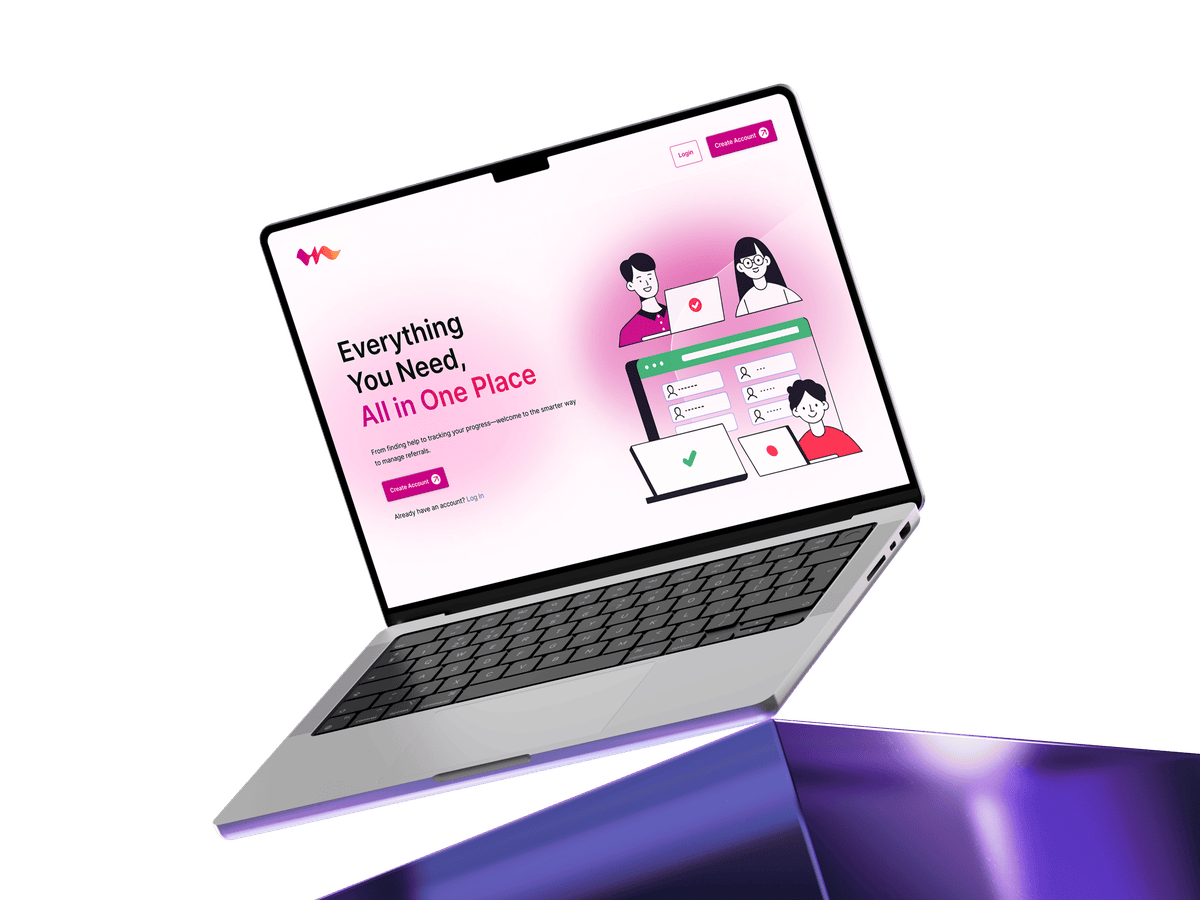
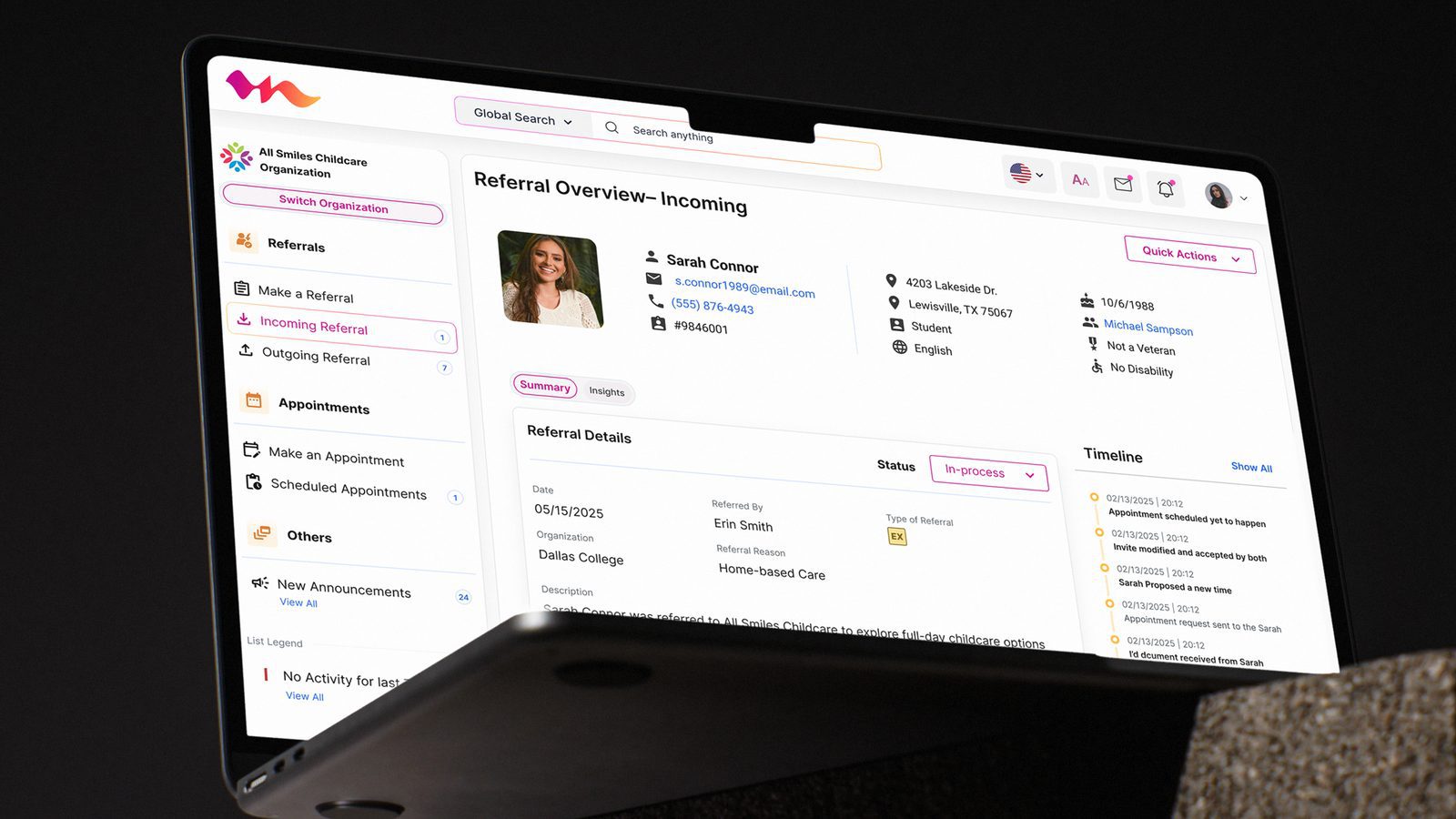
Laptop mockup showing the MyOneFlow referral platform welcome screen
Abstract network diagram of connected referral profiles, magenta duotone

The Problem

Organizations struggled with manual, fragmented referral workflows:

  • 40% referrals lost or incomplete
  • 48+ hour processing delays
  • Missing documentation & weak compliance
  • No visibility into referral status
  • Missed appointments & inconsistent follow-through—this directly impacted client outcomes and service coordination.

The Goal

Organizations needed a unified, automated referral experience that delivered faster processing, complete documentation, and transparent status tracking.

  • Digitize the entire referral journey end-to-end
  • Enable multi-service referrals in minutes
  • Automate compliance, documentation, and reminders
  • Shorten processing time from hours/days to minutes
  • Improve appointment attendance & service completion
  • Provide agencies real-time analytics & dashboards

Design Process

MyOneFlow followed a user-centered design and agile development loop:

Group of people icon
Empathize
interviewed case managers, administrators, and partner agencies; mapped referral frustrations
Alert triangle icon
Define
identified missing documentation, slow handoffs, lack of transparency
Clipboard icon
Ideate
solutions included auto-routing, multi-category referrals, compliance checklists
Prototype image icon
Prototype
low-fi flow → interactive prototypes → validated with users
Gear icon
Build
phased modular rollout, integrating APIs, appointments, analytics

User Research Highlights

Research revealed that staff often lacked visibility into referral progress, leading to duplicated work and communication gaps between agencies.

1

Highlight 1:

Users needed faster referral creation—current forms took too long.

2

Highlight 2:

Agencies required complete & compliant documentation upfront.

3

Highlight 3:

Users lacked visibility; often unaware of referral status or missing tasks.

4

Highlight 4:

Appointment no-shows were high due to no automated reminders.

Illustration of people and a magnifying glass representing user research

Pain Point

Organizations suffered from manual, fragmented referral workflows that caused delays, missing information, and constant follow-up.

1

Pain Point 1:

Manual referrals took 48+ hours & required multiple follow-ups.

2

Pain Point 2:

Incomplete documentation caused delays and compliance failures.

3

Pain Point 3:

No visibility into referral status across organizations.

4

Pain Point 4:

Appointment attendance was low because reminders weren’t automated.

Illustration of a wrench, gear, and question mark representing pain points

User Personas

Case managers struggled with disconnected tools and inconsistent referral steps that made it difficult to support clients efficiently.

Case manager reviewing documents, duotone magenta photo

Case Manager / Workforce Admin

  • Works in workforce or community service agency
  • Needs fast, accurate, compliant referral processing
  • Requires clear dashboards and client journey visibility

Goals

  • Track referral progress
  • Ensure documentation completeness
  • Improve service outcomes
  • Reduce no-shows

Frustrations

  • Missing documents
  • Confusing handoffs
  • High time-to-process
  • Lack of referral visibility

Motivations

Ease
Speed
Compliance
Accountability

Comparison Table

Aspect
Workflow
Documentation
Visibility
Service Coverage
Automation
Appointments
Analytics
Efficiency
Legacy Design
Manual, disconnected steps
Missing or incorrect files
No tracking across agencies
Single-service only
No automation
Manual, high no-shows
Limited or none
Time-consuming
New Design
Automated, unified referral pipeline
Real-time compliance checks
Live status updates & audit logs
Multi-service, multi-category referrals
Smart routing + reminders
Integrated scheduling + reminders
Dashboards with KPIs & bottlenecks
60% faster referral creation

User Flow

Dashboard Home Create Referral Client Profile Select Services
Referral Status Timeline Assign Agency Upload Documents
Manage Appointments View Dashboards

Hifi Mockups

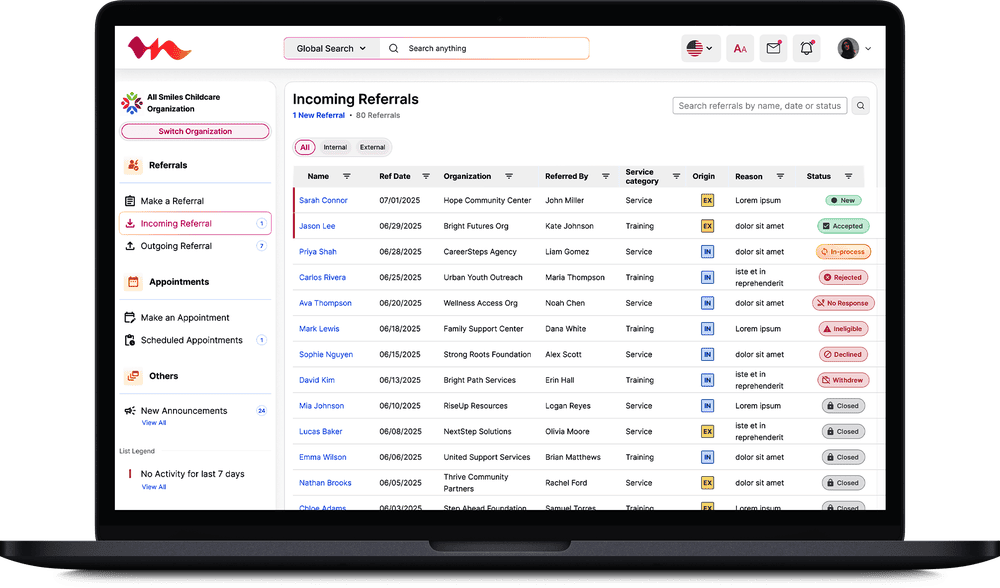
Laptop mockup: Incoming Referrals dashboard table
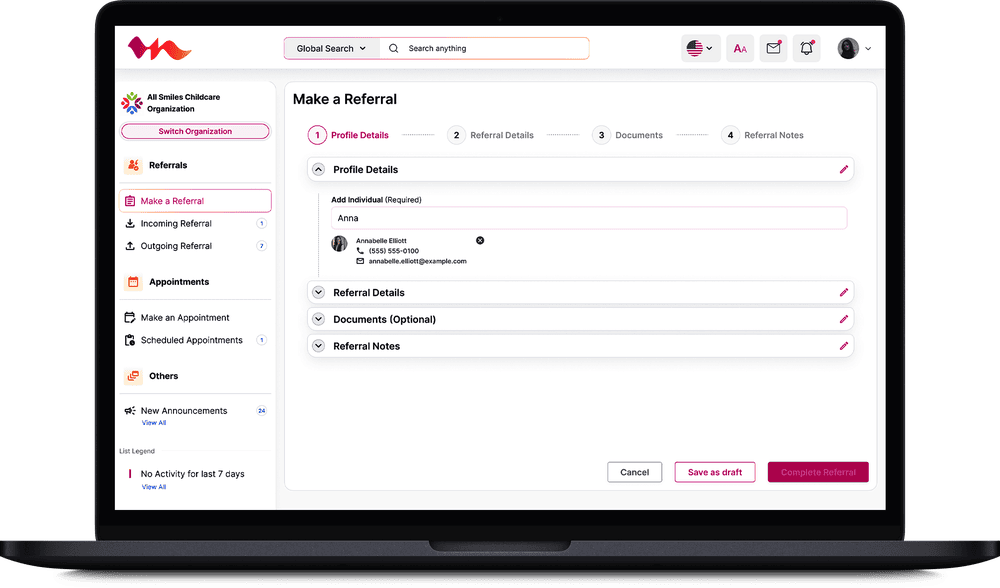
Laptop mockup: Make a Referral form, profile details step
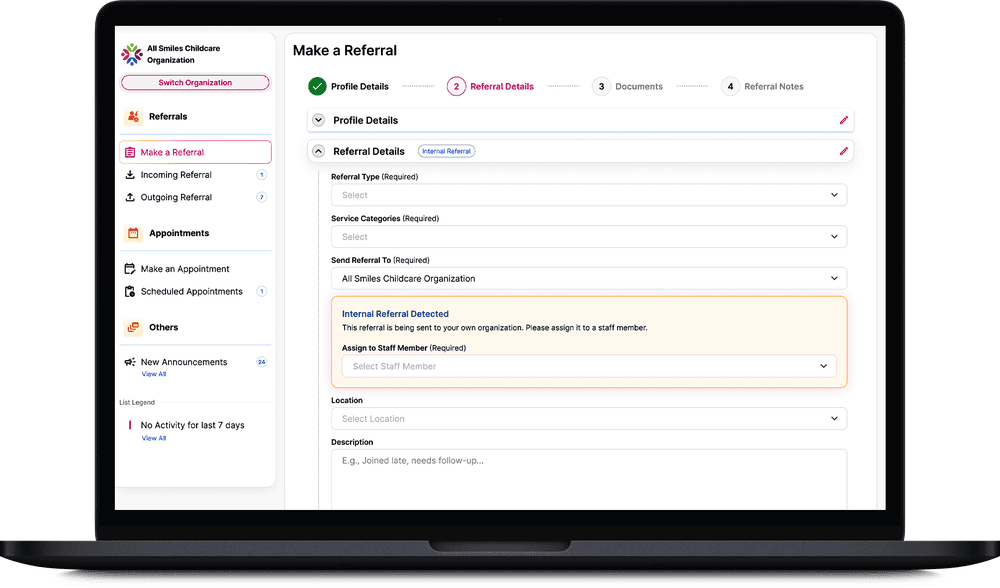
Laptop mockup: Make a Referral form, referral submitted confirmation
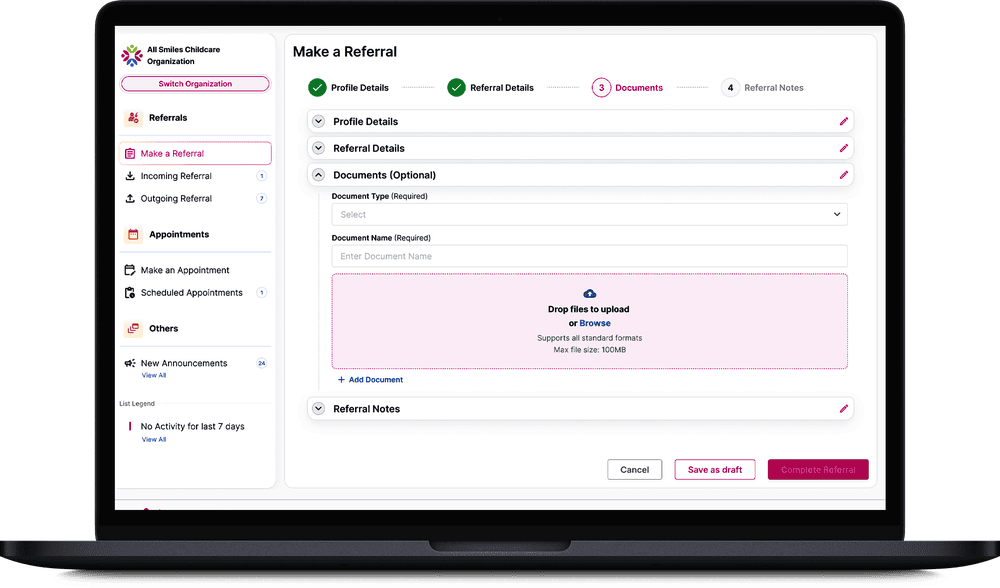
Laptop mockup: Make a Referral form, document upload step

Hifi Prototype Video

Prototype walkthrough video poster frame
Excited person celebrating results, duotone magenta photo with growth chart overlay

Impact & Result

Organizations achieved faster, more accurate referral processing with automation that eliminated manual delays and improved client outcomes.

↓

Processing Time

48 hours → <20 minutes

↑

Compliance

65% → 97%

↓

Appointment Attendance

55% → 87%

↑

Completion Rate

+35%

Lessons & Next Steps

Lessons

  • User-led design yields faster adoption
  • Automation significantly improves completion rates
  • Compliance built into the workflow reduces errors
  • Multi-service referrals simplify complex client needs

Next Steps

  • API partner integrations
  • AI-powered referral scoring
  • Expanded document intelligence
  • Mobile app companion
Our FAQ’s

Here are answers to some of the most common questions.

Discoverability issues, information overload, navigation reflecting org structure instead of customer goals, and low-visibility trust signals.
Instead of 'how do we simplify banking,' the team asked 'how do we help users make confident decisions faster.'
Key findings included that people scan before they read, visual structure builds trust, and complexity increases hesitation.
Prioritize user intent, reduce cognitive load, create predictable patterns, and surface critical actions.
Through WCAG-compliant inclusive interfaces, device-agnostic experiences, and international-readiness for diverse audiences.

Get in touch!

© 2026 | All rights reserved

Work with Vikas

Need a Product Design Leader Who Turns Complexity into Clarity?

25+ years leading product design for banking, insurance, energy and SaaS teams. Tell me what you are building and where it is stuck.

    © 2026 | All rights reserved